Products

Driven by precision, trusted for performance. We provide CNC solutions that manufacturers rely on—every day, worldwide.

Newsroom

Explore our latest updates—from product launches and trade shows to success stories across the machining world.

What Is Swiss Machining? The Ultimate 2026 Guide

Swiss machining is a precision turning method for small, high-tolerance parts commonly used in the medical, aerospace, and electronics industries. 

In this guide, we’ll explain what Swiss machining is, how it works, which machine configurations exist in 2026, and how to decide whether a Swiss lathe machine fits your production needs.

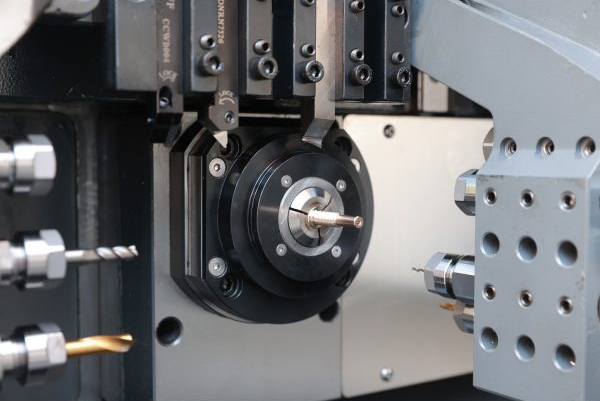
Swiss machining

What is Swiss Machining

In short, Swiss machining is a class of turning where the workpiece is supported near the cutting zone by a guide bushing, reducing deflection and enabling high repeatability for long, slender parts.

Swiss machine

Types of Swiss Machining

Swiss machining includes cam-type Swiss screw machines, CNC Swiss-type lathes, multi-axis Swiss machines, and Swiss turn-mill hybrids.

Cam-Type Swiss Screw Machines

Cam-type (mechanical) Swiss screw machines use rotating cams to drive tool movements. They produce very high part volumes at low per-part cost but are inflexible once set up.

CNC Swiss-type Lathes (Swiss CNC Lathe)

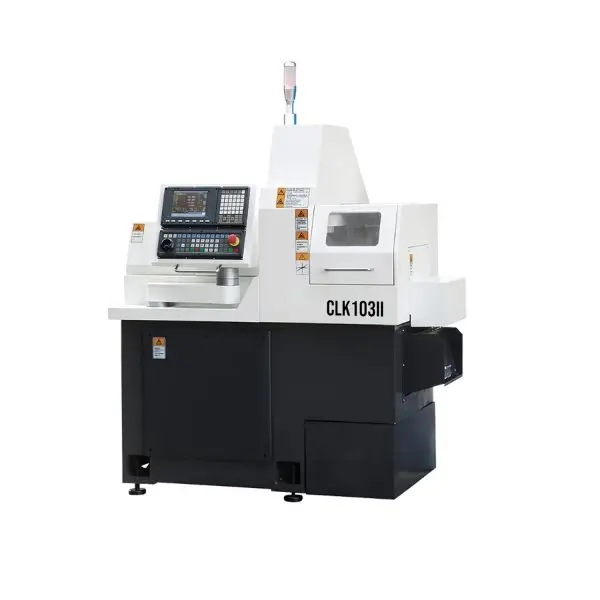
A CNC Swiss-type lathe, also named as the Swiss CNC lathe, replaces mechanical cams with computer-controlled servomotors, reducing changeover time to 30–90 minutes and enabling fast reprogramming for new geometries.

At present, the majority of precision component shops in North America, Europe, and East Asia now operate CNC Swiss-type lathes as their primary small-part production platform.

Multi-axis Swiss Machines

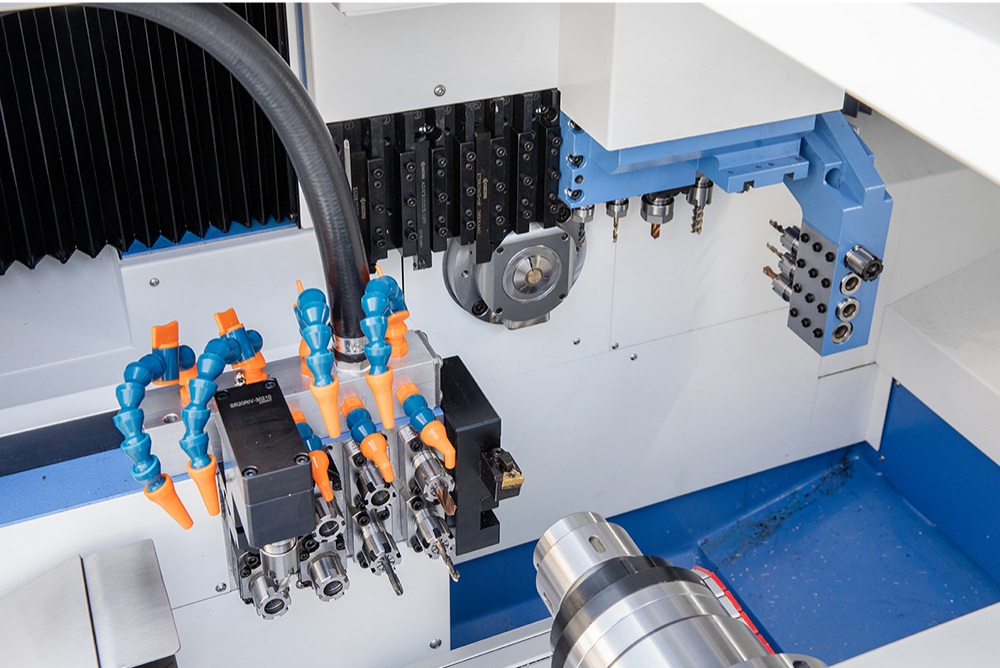
Multi-axis Swiss machines add simultaneous live-tool axes (Y-axis milling, B-axis contouring) so complex features, like cross-holes, flats, and helical grooves, are completed in one setup without re-fixturing. Therefore, they’re particularly useful for aerospace and medical parts requiring off-centerline features.

Swiss Turn-mill Machines

Swiss turn-mill machines integrate rotary milling spindles with the sliding headstock, producing parts that combine turned surfaces, milled pockets, and drilled features in a single clamping. These machines eliminate the secondary milling operation and the associated re-fixturing tolerance stack-up.

Swiss turn-mill machines

How Swiss Machining Works

Swiss machining works by feeding bar stock axially through a fixed guide bushing while the headstock moves in the Z direction, cutting tools positioned immediately after the bushing engagement point act on material that is always rigidly supported.

  • The process generally follows these steps:
  • Bar stock feeds through the guide bushing.
  • Sliding headstock moves the material precisely.
  • Cutting tools remove material incrementally.
  • Main spindle and sub-spindle coordinate operations.
  • Finished parts separate automatically.
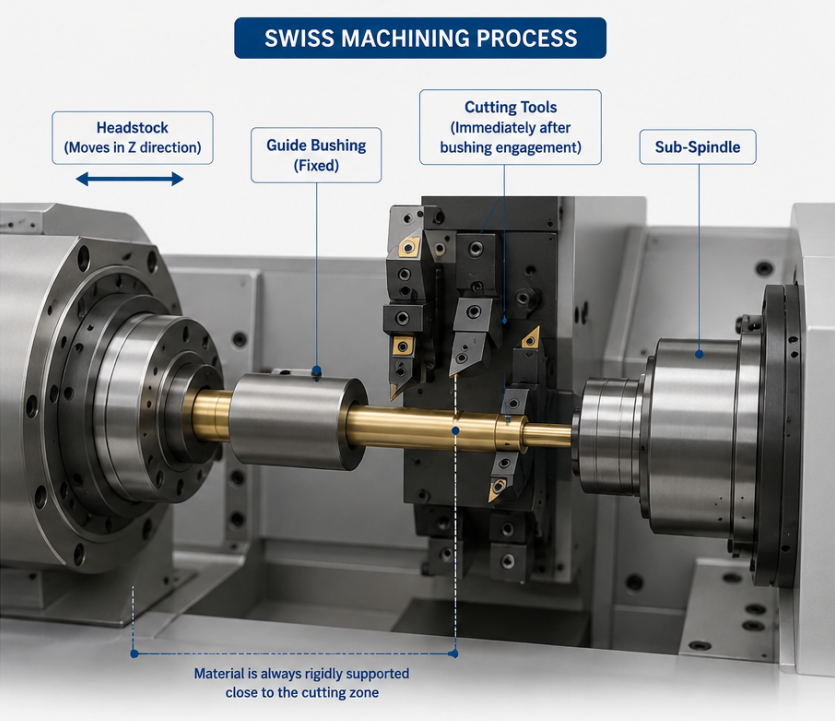
Swiss machining process

Key Characteristics of Swiss Machining

A Swiss machine’s core components include guide bushing, sliding headstock, main and subspindles, live tooling, tool post, and bar feeder, all determining its processing envelope and suitability.

Understanding each subsystem is essential when specifying or evaluating a CNC Swiss machine:

  • Guide Bushing: Supports the bar stock at the cutting zone.
  • Sliding Headstock: Moves axially to feed bar stock through the guide bushing.
  • Main Spindle: Rotates the bar at programmed speeds.
  • Sub-Spindle: A second spindle, opposite the main spindle, that accepts the part after cutoff for back-side machining.
  • Live Tooling: Powered rotary tool holders that drive milling cutters, drills, and taps.
  • Tool Post: The gang-tool plate or turret that holds fixed and live tools.
  • Bar Feeder: Automatically advances bar stock into the machine.
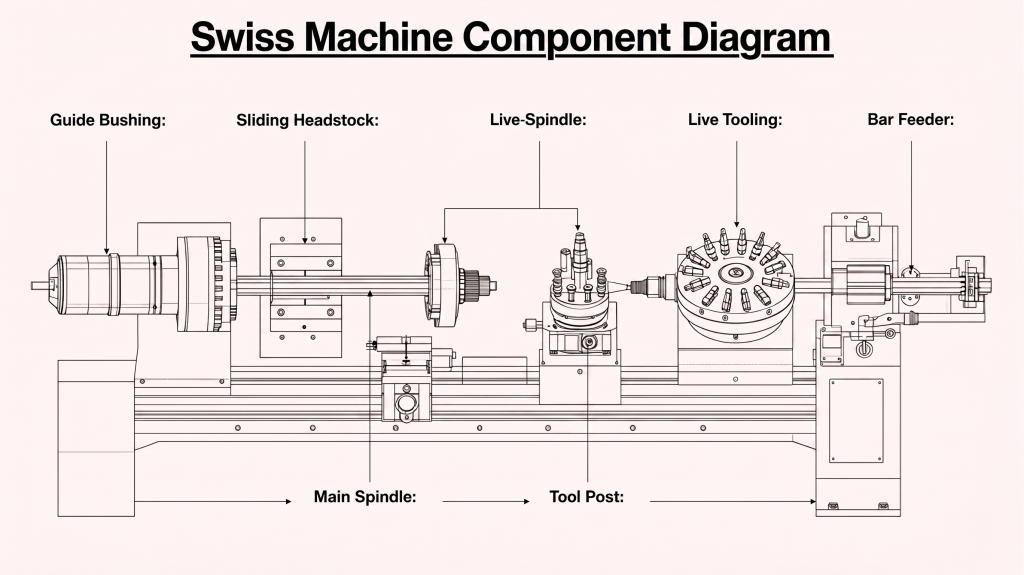
Swiss machining components

How about the Swiss machine’s key specifications? Actually, it’s usually grouped into four categories: processing capacity, mechanical capacity, tooling system, and motor power. Each directly affecting part’s capability and output rate.

FeatureStandard Range
Processing Capacity0.5mm to 32mm diameter (Standard); up to 38mm (Large)
Mechanical CapacitySpindle runout ≤0.002 mm; repeated positioning accuracy ≤0.003 mm
Tool SystemGang-tooling or Turret-based; up to 40+ tools
Motor Power3.7kW to 7.5kW for main spindles

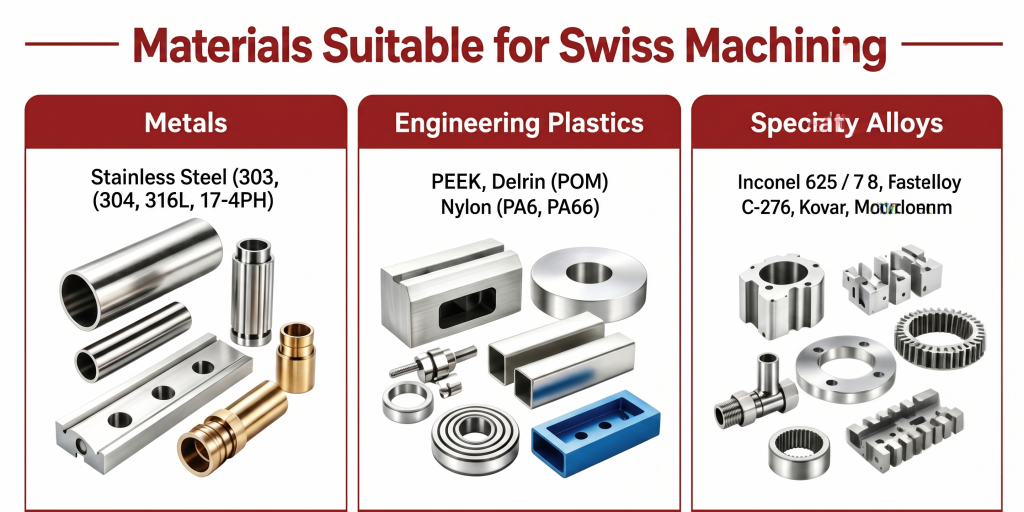
Materials Suitable for Swiss Machining

Swiss machining works with a wide range of materials, including common metals, engineering plastics, and exotic alloys, but each requires specific tooling and cutting strategies.

The specific materials are the following:

Metals

Common metals include:

  • Stainless Steel (303, 304, 316L, 17-4PH)
  • Titanium (Grade 2, Grade 5 / Ti-6Al-4V)
  • Brass (C360, C260)
  • Aluminum (6061-T6, 7075-T6)
  • Copper Alloys

Plastics

Swiss machining also supports engineering plastics, such as:

  • PEEK
  • Delrin (POM)
  • Nylon (PA6, PA66)
  • PTFE

Exotic Alloys

High-performance industries often require difficult-to-machine alloys, such as:

  • Inconel 625 / 718
  • Hastelloy C-276
  • Kovar
  • Molybdenum
Materials suitable for Swiss machining

Applications of Swiss Machining

Swiss machining is used where small size, tight tolerances, and complex axial features are required, covering markets from watchmaking to aerospace and semiconductors.

1. Watchmaking

Mechanical watch movements contain 100–400 individual components, many with diameters under 1.5 mm. Swiss machining on cam-type and CNC Swiss lathes remains the standard production method for watch pinions, jewel settings, and balance wheel components.

2. Aerospace & Defense

Flight-critical fasteners, such as hydraulic valve spools, gyroscope components, and fuel injector nozzles are produced on Swiss machines, due to they require the AS9100 quality systems in the aerospace industry.

3. Medical Devices

Bone screws (diameters 1.5–6.5 mm), spinal implant set screws, catheter components, and surgical instrument shafts are high-volume Swiss machining applications. These parts require extremely tight tolerances and clean surface finishes.

4. Space & Satellite

Satellite systems contain miniature connectors and thermal control components that require high dimensional stability. Swiss machining helps maintain consistency during low-volume, high-precision aerospace production.

5. Electrical Components

Electrical industries use Swiss machines for connectors, pins, contact terminals and conductive fittings. Brass C360 is the dominant material due to its machinability rating of 100 (ASTM B16 reference standard) and its conductivity characteristics.

6. Semiconductor

Wafer handling components, probe pins, and precision semiconductor test equipment parts require dimensional tolerances that only Swiss machining can achieve in volume. Aluminum 6061-T6 and PEEK are the most common materials in this segment.

7. Automotive

Fuel injection nozzles, ABS sensor housings, turbocharger shaft components, and transmission valve spools are Swiss machining applications in the automotive sector. IATF 16949 process requirements align with the statistical process control capabilities of modern CNC Swiss machines.

8. Musical Instruments

High-end musical instruments use Swiss-machined valves, pins, and tuning assemblies. Tolerances of ±0.01–0.02 mm on these parts directly affect the intonation and action of the instrument.

9. Communications

RF (radio frequency) connector pins, coaxial contact elements, and fiber optic alignment ferrules are precision Swiss machining applications. Ferrule bore concentricity of under 0.001 mm is a standard specification in IEC 61754-series fiber optic connector standards.

10. Pneumatics & Hydraulics

Valve spools, needle valves, and hydraulic cartridge valve bodies with diameters in the 6–32 mm range are produced on CNC Swiss-type lathes. Surface finish specifications of Ra ≤ 0.4 µm on sealing diameters are routinely achieved by Swiss machining in a single setup.
Swiss machining application

Common Confusion: Swiss Machining VS Other CNC Processes

Many people are confused about Swiss machining with conventional CNC turning and CNC milling. The main differences are workpiece support, typical geometries, and the kinds of features each method economically produces.

Swiss Machining vs Conventional CNC Turning

Swiss machining uses a guide bushing and performs cutting near the support point, making it better for long, thin parts. While conventional CNC turning is more suitable for short, large-diameter shafts and parts without long unsupported sections.

Swiss Machining vs CNC milling

CNC milling excels at complex 3D contouring and flat surfaces. Swiss machining excels at high-repeatability, axisymmetric parts that require fine axial features and multi-operation sequences in a single machine.

Source Swiss Machining Equipment Through Leichman

Leichman provides industrial-grade Swiss lathe machines engineered for 0.003mm repeatability and high-speed production, helping buyers achieve reliable precision while keeping procurement and operating costs under control.
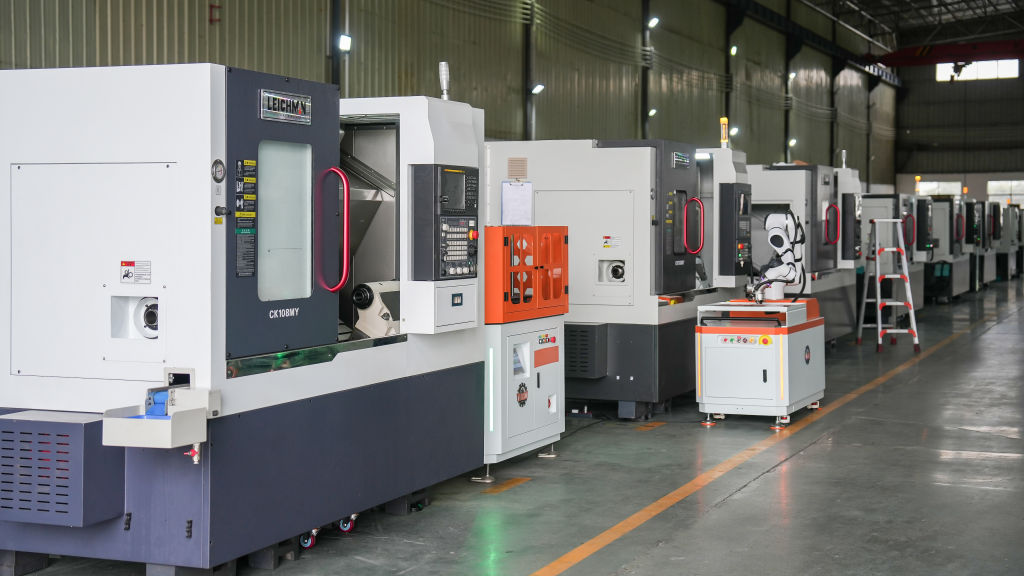
When selecting a CNC Swiss machine from Leichman, buyers should prioritize the following procurement quick checklist:
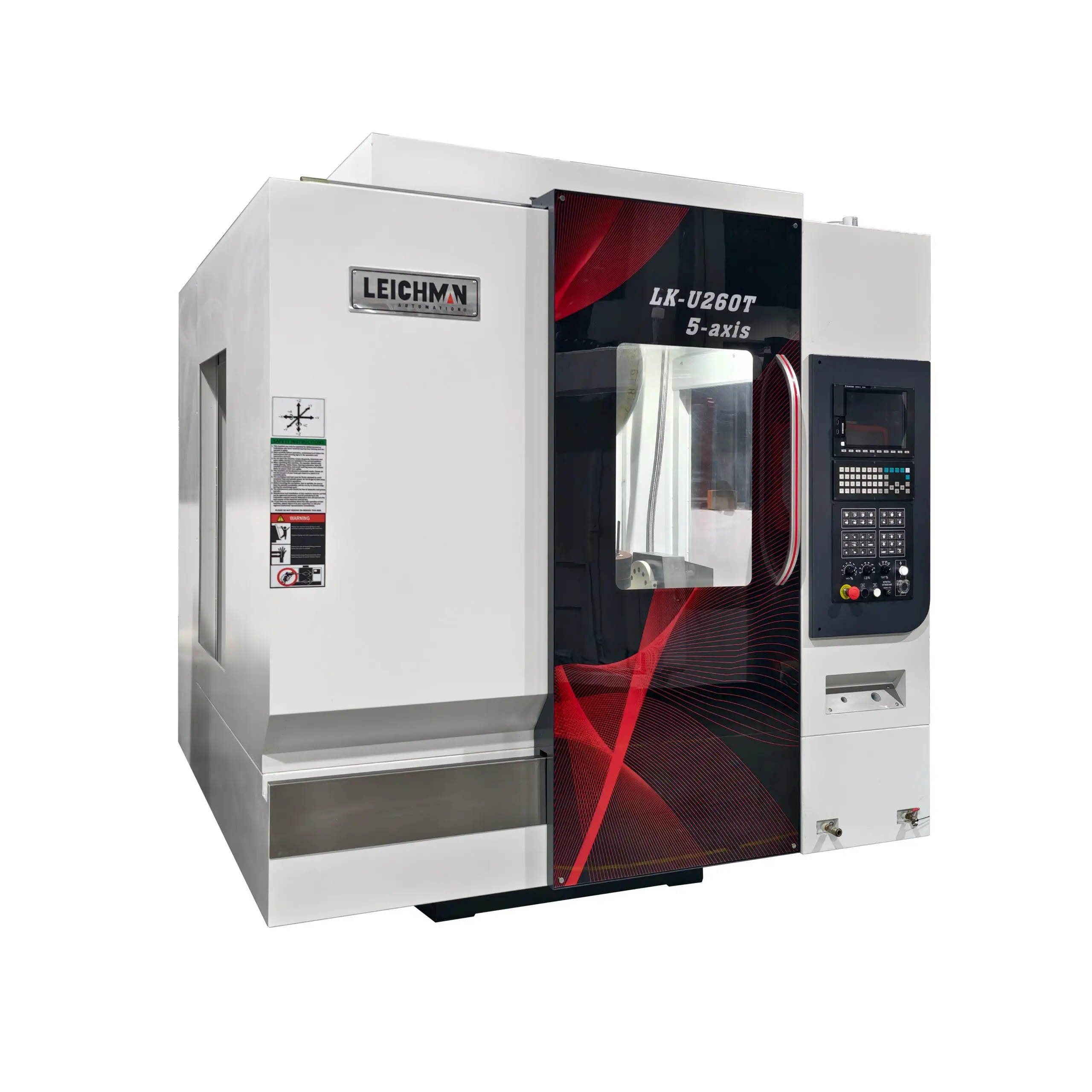
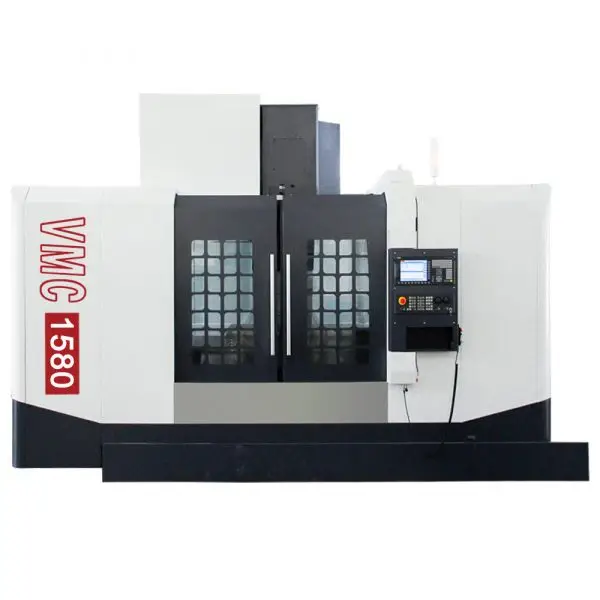
Procurement Quick Checklist

For current pricing, lead times, and machine availability, contact us right now!

Share:

Facebook
Twitter
Email
Print

Get a Quote